
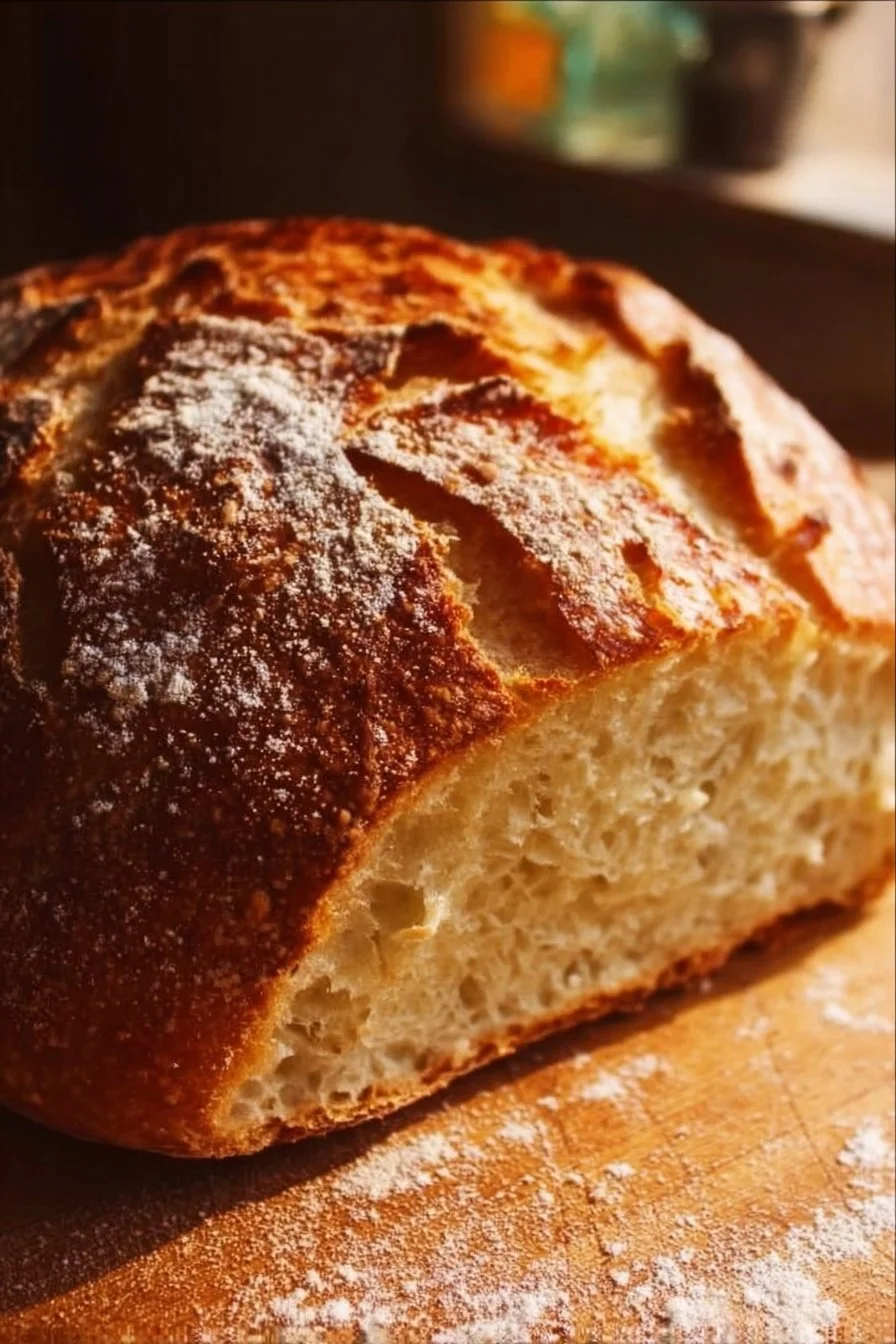
This no-fuss no-knead loaf produces a crisp, golden crust and an open, chewy crumb with almost no hands-on time — ideal for busy evenings and weekend baking alike. It’s the kind of bread that makes your kitchen smell like a bakery and pairs with everything from soup to Sunday breakfast sandwiches. If you want a savory spin after trying this basic version, I often reach for the flavorful no-knead garlic-herb Dutch oven bread for company at the table.
Why you’ll love this dish
No-knead bread is beloved because it turns minimal effort into maximum flavor. With a long, slow rest and high-heat baking inside a preheated Dutch oven, the dough develops flavor and steam builds a crackly crust — the technique does the work for you.
“I expected dense homemade bread, but this loaf had a bakery-style crust and airy inside — and I didn’t even knead it.” — a repeat tester
Perfect occasions: weeknight dinners where you want fresh bread without babysitting dough, cozy breakfasts, or an easy centerpiece for casual entertaining. It’s budget friendly, uses pantry staples, and is forgiving for new bakers.
Step-by-step overview
This recipe follows four simple phases: mix, rest, shape, and bake. First you combine flour, salt, and instant yeast, then stir in warm water to form a wet, shaggy dough. A long, hands-off rest (12–18 hours) allows flavor and gluten structure to develop. After shaping, the loaf bakes inside a hot Dutch oven so steam traps and gives you that blistered crust. Expect active time under 20 minutes and total elapsed time about 13–19 hours including the overnight rise.
What you’ll need
- 2 cups (about 250 g) all-purpose flour — unbleached gives better flavor.
- 1/2 teaspoon fine salt — adjust to taste but don’t omit.
- 1/2 teaspoon instant yeast — no need to proof; sprinkle directly into flour.
- 1 cup (240 ml) warm water — around 95–105°F (35–40°C); not scalding.
Substitutions and notes:
- For a nuttier flavor, replace up to 25% of the flour with whole-wheat flour (expect a slightly denser crumb).
- If you only have active dry yeast, dissolve it in the warm water for 5–10 minutes before mixing (see FAQ).
- For a quicker alternative that streamlines shaping and hydration, some home bakers try a related shortcut like the 4-ingredient artisan bread — but this recipe keeps the classic slow rest for deeper flavor.
Step-by-step instructions
- In a large bowl, whisk together the flour, salt, and instant yeast until evenly combined.
- Pour in the warm water and stir with a wooden spoon or spatula until a sticky, shaggy dough forms; it will be wetter than sandwich bread.
- Cover the bowl tightly with plastic wrap or a reusable lid and leave at room temperature for 12 to 18 hours. The surface should be dotted with bubbles and roughly doubled.
- When ready to bake, place a clean Dutch oven (with its lid) in the oven and preheat to 450°F (230°C) for 30 minutes so the pot becomes blazing hot.
- Turn the dough onto a well-floured surface; gently shape it into a round by folding the edges underneath a few times to build surface tension. Avoid deflating all the air.
- Carefully place the dough seam-side down into the hot Dutch oven — using parchment paper to lift it is safer and easier. Score the top if you want controlled expansion.
- Bake 30 minutes with the lid on, then remove the lid and bake an additional 15 minutes to brown and crisp the crust. The loaf is done when it’s deep golden and the internal temperature reads 205–210°F (96–99°C).
- Transfer the loaf to a wire rack and cool for at least 30 minutes before slicing to finish setting the crumb.
Best ways to enjoy it
Serve slices warm with butter, olive oil and sea salt, or alongside soups and stews. For breakfast, toast thick slices and top with jam, ricotta and honey, or avocado and lemon. Turn day-old bread into panzanella, croutons, or French toast — the dense crumb holds up beautifully.
Storage and reheating tips
- Room temperature: store in a paper bag or a loose linen bread bag for 1–2 days to keep the crust crisp. Avoid sealed plastic if you want to preserve crust texture.
- Freezing: slice and wrap tightly in plastic, then foil, or use a freezer bag; freeze up to 3 months. Thaw at room temperature or toast slices straight from frozen.
- Reheating: for a fresh-baked feel, reheat whole or halved loaf in a 350°F (175°C) oven for 10–15 minutes. For individual slices, toast or warm in a skillet with a pat of butter.
- Food safety: because this is a yeast-fermented bread, refrigeration is unnecessary and will speed staling; freeze instead for longer storage.
Pro chef tips
- Hydration matters: the dough should be sticky; resist adding too much flour when shaping. A wet dough yields larger holes inside the crumb.
- Temperature and timing: room temperature and yeast activity influence the 12–18 hour window — warmer kitchens shorten it. Look for bubbles and a domed surface rather than relying strictly on time.
- Use parchment for safer handling: place dough on a square of parchment before placing it in the Dutch oven; you can lift the whole package.
- Crust preference: for an ultra-crisp crust, remove the lid earlier by 5 minutes; for a chewier crust, keep it covered slightly longer.
- Don’t slice hot: cooling lets steam redistribute and finish cooking the crumb; cutting too soon makes the loaf gummy.
Creative twists
- Herb and garlic: fold in 1–2 teaspoons minced garlic and 1 tablespoon chopped fresh herbs right before shaping.
- Seeds and grains: sprinkle sesame, sunflower, or a mix on top after moistening the surface with a little water.
- Cheese swirl: fold in 1/2 cup grated hard cheese (Parmesan, cheddar) during shaping for a savory pull-apart loaf.
- Whole-wheat or rye blend: replace up to 30% of the flour with whole-wheat or rye for earthier flavor; increase water slightly.
- No-Dutch-oven option: bake on a preheated baking stone and place a metal pan with boiling water on the lower rack to create steam (results differ slightly).
Common questions
Q: Can I use active dry yeast instead of instant yeast?
A: Yes. Dissolve 1/2 teaspoon active dry yeast in the warm water and let it sit 5–10 minutes until foamy, then mix with the flour and salt. The rest of the process stays the same.
Q: How will I know the dough has risen enough after 12–18 hours?
A: Look for bubbles on the surface, a slightly domed appearance, and a dough that feels aerated when you gently press it. If it’s very bubbly and doubled, it’s ready; if not, give it another hour or two.
Q: Can I make this in a bread machine or without a Dutch oven?
A: The no-knead method is not designed for bread machines since the long slow rest is key. If you don’t have a Dutch oven, bake on a preheated baking stone or heavy sheet and add steam to the oven (see Creative twists). Expect a slightly different crust and oven spring.
Q: How long will the loaf stay fresh?
A: Best within 48 hours at room temperature for flavor and crust quality. Freeze for longer storage up to 3 months.
Q: Is this recipe suitable for beginners?
A: Absolutely — it’s purpose-built for minimal technique and forgiving timing. Follow the resting cues and use the tips above for the best results.
Enjoy the simple pleasure of walking into your kitchen and smelling a fresh loaf — this no-knead method gives you great bread without the elbow grease.
Print
No-Knead Bread
- Total Time: 13–19 hours
- Yield: 1 loaf
- Diet: Vegetarian
Description
A simple no-knead loaf with a crisp crust and chewy crumb, perfect for busy evenings and casual entertaining.
Ingredients
- 2 cups (250 g) all-purpose flour, unbleached
- 1/2 teaspoon fine salt
- 1/2 teaspoon instant yeast
- 1 cup (240 ml) warm water (95–105°F or 35–40°C)
Instructions
- In a large bowl, whisk together the flour, salt, and instant yeast until combined.
- Pour in the warm water and stir until a sticky, shaggy dough forms.
- Cover the bowl tightly and rest at room temperature for 12 to 18 hours.
- Preheat a clean Dutch oven to 450°F (230°C) for 30 minutes.
- Turn the dough onto a floured surface and shape into a round.
- Place the dough seam-side down into the hot Dutch oven.
- Bake with the lid on for 30 minutes, then remove the lid and bake for an additional 15 minutes.
- Cool for at least 30 minutes before slicing.
Notes
For variations, try adding minced garlic, fresh herbs, or grated cheese. Store in a paper bag for 1-2 days, or freeze for up to 3 months.
- Prep Time: 20 minutes
- Cook Time: 45 minutes
- Category: Bread
- Method: Baking
- Cuisine: American