

I still make a big batch of these Korean BBQ meatballs when friends come over — they disappear fast. Savory, slightly sweet meatballs flecked with ginger and scallion, paired with a creamy, spicy gochujang mayo that brightens every bite. They work as a weeknight dinner, game-day finger food, or an easy party appetizer that feels a little special without a lot of fuss. If you want a skillet-friendly shortcut or inspiration from a similar recipe, see this helpful write-up on Korean BBQ meatballs for variations and timing tips.
Why you’ll love this dish
These meatballs hit a lot of cooking sweet spots: bold Korean flavors, minimal hands-on time, and flexible cooking methods (bake, pan-fry, or grill). They’re kid-friendly but grown-up enough for guests because gochujang adds a complex chili-sweet umami that’s easy to tame with honey or lime. Make a double batch and you’ve got great leftovers for lunches.
“Perfect balance of sweet, salty, and spicy — sticky on the outside, juicy inside. A real crowd-pleaser.” — home cook review
What sets them apart is the gochujang in both the meat and the dip. That repeated flavor thread gives you a coherent, restaurant-style bite without complicated technique.
The cooking process explained
Start by mixing the meat gently — overworking develops gluten and makes meatballs tough. Use panko and an egg to bind, but avoid squeezing the mixture. Shape uniform balls so they cook evenly. Choose your finish: baking for hands-off reliability, pan-frying for the crispiest crust, or grilling for a smoky note. While the meatballs cook, whisk the spicy mayo so it’s ready for dipping as soon as the meatballs hit the plate.
What you’ll need
- 1 lb (450 g) ground beef or ground chicken — beef gives richer flavor; chicken keeps them lighter.
- 1/2 cup panko breadcrumbs — for a light interior.
- 1 large egg — binder.
- 2 cloves garlic, minced.
- 1-inch piece ginger, grated (about 1 tsp) — fresh is best.
- 2 tablespoons soy sauce.
- 1 tablespoon gochujang (Korean chili paste) — adjust to taste.
- 1 tablespoon brown sugar.
- 1 tablespoon sesame oil.
- 1/2 teaspoon salt.
- 1/4 teaspoon black pepper.
- 2 green onions, finely chopped.
For the spicy mayo dip:
- 1/2 cup mayonnaise.
- 1 tablespoon gochujang.
- 1 tablespoon lime juice (or rice vinegar).
- 1 teaspoon honey.
- 1/2 teaspoon garlic powder.
Ingredient notes and substitutions:
- Use low-sodium soy sauce if you want more control over salt.
- Panko can be swapped for regular breadcrumbs, but texture will be denser.
- Gochujang is salty and spicy; for milder dip, start with 1/2 tablespoon and taste.
- To make these gluten-free, swap panko for gluten-free breadcrumbs and use tamari instead of soy.
Step-by-step instructions
- In a large bowl combine ground meat, panko, egg, minced garlic, grated ginger, soy sauce, gochujang, brown sugar, sesame oil, salt, pepper, and green onions. Mix gently until just combined. Stop as soon as there are no big streaks of egg.
- Scoop and roll the mixture into evenly sized meatballs, about 1 to 1.5 inches in diameter. Uniform size = even cooking.
- Arrange meatballs on a plate or baking sheet while you preheat your cooking surface.
- Choose a cooking method:
- Bake: Preheat oven to 400°F (200°C). Place meatballs on a lightly oiled sheet pan or a rack and bake 15–20 minutes, until internal temp is 160°F (71°C) for beef or 165°F (74°C) for chicken.
- Pan-fry: Heat 1–2 tablespoons neutral oil in a skillet over medium-high. Brown meatballs on all sides, turning every 2–3 minutes, then reduce heat and cook until done (total 10–12 minutes).
- Grill: Oil grates and grill over medium heat. Rotate to get good char and cook through, about 8–12 minutes depending on size.
- While the meatballs cook, whisk together mayonnaise, gochujang, lime juice, honey, and garlic powder until smooth. Taste and adjust lime or honey to balance heat.
- Serve meatballs warm with the spicy mayo on the side for dipping.
Best ways to enjoy it
Serve them as bite-sized appetizers on skewers, or turn them into a main course:
- Over steamed rice with quick-pickled cucumbers and extra scallions.
- In slider buns with crisp kimchi for a tasty sandwich.
- Tossed into a noodle bowl with blanched greens and a drizzle of the mayo.
If you prefer slow-cooked, saucier meatballs, try an alternate method like the easy crockpot pineapple BBQ meatballs for a sweeter, fall-apart texture — it’s a different style but the serving concept is similar.
Pairing suggestions:
- Light lager or Korean rice beer (makgeolli-style cocktails).
- Crisp green salads, steamed bok choy, or sesame-roasted broccoli.
Storage and reheating tips
- Refrigeration: Cool to room temperature no longer than 2 hours after cooking, then refrigerate in an airtight container. Use within 3–4 days.
- Freezing: Freeze cooked meatballs in a single layer on a tray, then transfer to a freezer bag. Keep up to 3 months.
- Thawing: Thaw overnight in the refrigerator.
- Reheating: Reheat in a 350°F (175°C) oven for 8–12 minutes (from refrigerated) until 165°F (74°C) internal. Microwave works for quick reheats but can dry them out; cover with a damp paper towel and use short bursts. For best texture, re-crisp in a hot skillet for 1–2 minutes per side after reheating.
- Safety: Always reheat until steaming hot throughout. If using raw ground chicken, ensure the final internal temperature reaches 165°F (74°C).
Helpful cooking tips
- Don’t overmix: Stir just until ingredients come together.
- Uniform scoops: Use a small cookie scoop for consistent meatballs.
- Chill briefly: If the mixture feels sticky, chill 10–15 minutes — it’s easier to roll.
- Sear first for texture: If baking, quickly brown meatballs in a hot skillet for 1–2 minutes before finishing in the oven to add color.
- Check doneness with a thermometer: It’s the safest, most reliable method.
- Sauce glaze option: Brush a thin glaze of soy, gochujang, and honey in the last few minutes of cooking for a shiny finish.
Recipe variations
- Turkey or pork: Swap the beef/chicken for ground turkey or pork. Adjust salt as needed.
- Vegetarian: Use a firm mashed chickpea or tofu base with additional binder (1 extra tablespoon flaxseed+water or extra panko).
- Extra sticky glaze: Reduce equal parts gochujang and honey in a small saucepan and brush on at the end.
- Spicy ramp-up: Add 1/2 teaspoon Korean chili flakes (gochugaru) to the mix.
- Sesame crunch: Garnish with toasted sesame seeds and thinly sliced scallions for texture.
- Low-fat option: Bake lean ground chicken and serve with a yogurt-based dip instead of mayo.
Common questions
Q: How long does this recipe take from start to finish?
A: Active prep is about 15–20 minutes (mixing, shaping). Cooking is 12–20 minutes depending on method, so total time is roughly 30–45 minutes.
Q: Can I make these ahead for a party?
A: Yes — shape the meatballs and refrigerate them covered for up to 24 hours before cooking. You can also fully cook and reheat as needed. For large gatherings, bake ahead and keep warm in a low oven (200°F / 93°C) on a baking tray.
Q: What if I don’t have gochujang?
A: Substitute a mix of miso + chili paste + a pinch of sugar to approximate the sweet-umami heat, but flavor won’t be identical. Or use a mild chili paste and increase honey slightly.
Q: Are the meatballs freezer-friendly?
A: Yes. Freeze cooked meatballs for up to 3 months. Thaw overnight in the fridge before reheating.
Q: How spicy will these be for kids?
A: Mild to moderate. Gochujang is more sweet-umami than blazing heat. Reduce the amount in the meat and dip for a kid-friendly version, or serve dip on the side so kids can choose.
If you want extra inspiration for different cooking methods and timing, the linked recipes above provide helpful comparisons and technique notes.
Print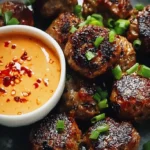
Korean BBQ Meatballs
- Total Time: 40 minutes
- Yield: 4 servings
- Diet: Gluten-Free
Description
Savory, slightly sweet meatballs with Korean flavors served with a creamy, spicy gochujang mayo.
Ingredients
- 1 lb (450 g) ground beef or ground chicken
- 1/2 cup panko breadcrumbs
- 1 large egg
- 2 cloves garlic, minced
- 1-inch piece ginger, grated (about 1 tsp)
- 2 tablespoons soy sauce
- 1 tablespoon gochujang (Korean chili paste)
- 1 tablespoon brown sugar
- 1 tablespoon sesame oil
- 1/2 teaspoon salt
- 1/4 teaspoon black pepper
- 2 green onions, finely chopped
- For the spicy mayo dip:
- 1/2 cup mayonnaise
- 1 tablespoon gochujang
- 1 tablespoon lime juice (or rice vinegar)
- 1 teaspoon honey
- 1/2 teaspoon garlic powder
Instructions
- In a large bowl combine ground meat, panko, egg, minced garlic, grated ginger, soy sauce, gochujang, brown sugar, sesame oil, salt, pepper, and green onions. Mix gently until just combined.
- Scoop and roll the mixture into evenly sized meatballs, about 1 to 1.5 inches in diameter.
- Choose a cooking method:
- Bake: Preheat oven to 400°F (200°C). Bake meatballs on a lightly oiled sheet pan for 15–20 minutes.
- Pan-fry: Heat oil in a skillet over medium-high, brown meatballs on all sides, cook until done (10–12 minutes).
- Grill: Oil grates and grill over medium heat for 8–12 minutes.
- While the meatballs cook, whisk together mayonnaise, gochujang, lime juice, honey, and garlic powder until smooth.
- Serve meatballs warm with the spicy mayo on the side for dipping.
Notes
For a gluten-free option, use gluten-free breadcrumbs and tamari instead of soy sauce. Adjust gochujang to taste for spice level.
- Prep Time: 20 minutes
- Cook Time: 20 minutes
- Category: Appetizer
- Method: Baking, Pan-Frying, Grilling
- Cuisine: Korean