
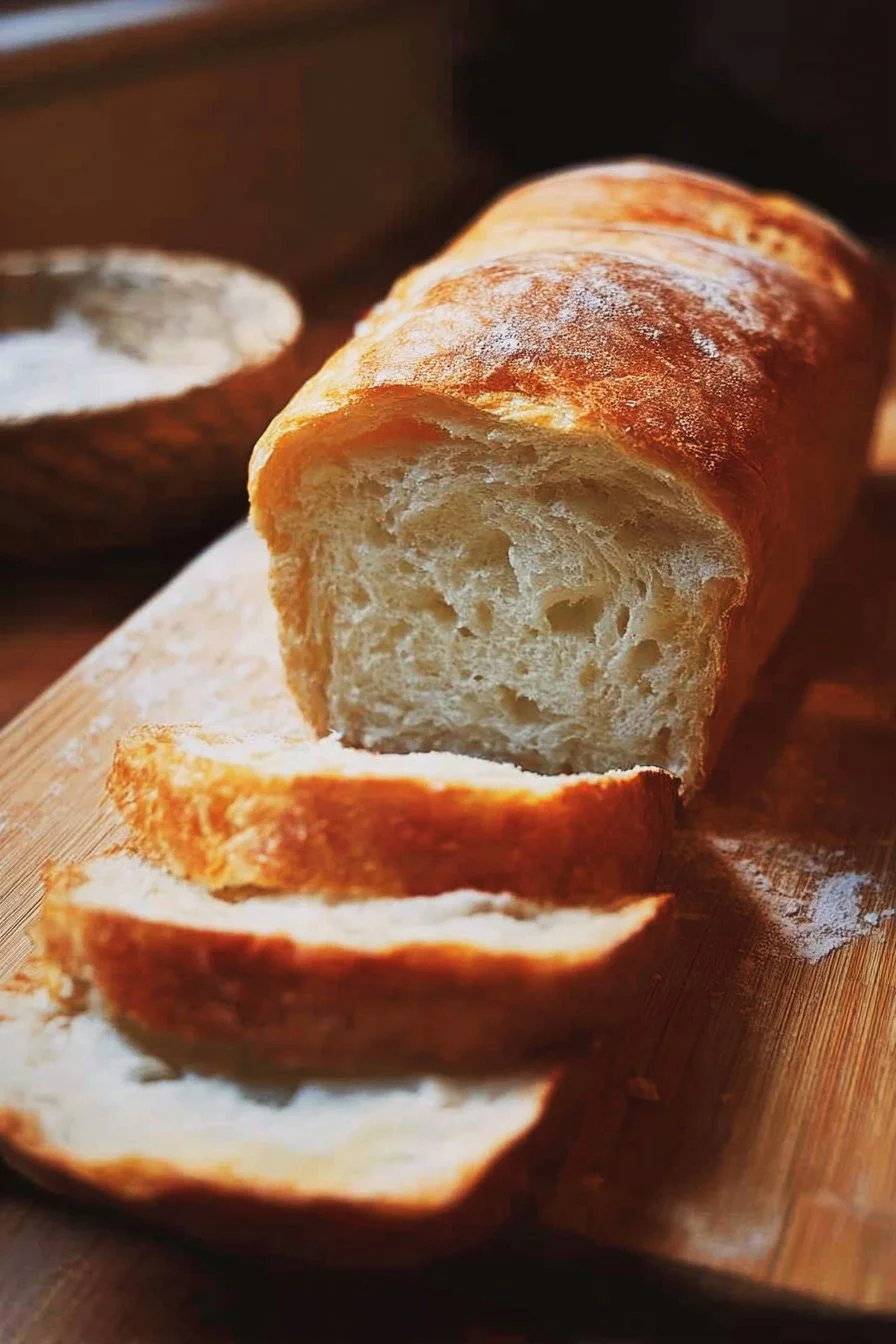
Warm, soft, and unfussy — this everyday loaf is the kind of bread you bake so often it becomes part of the weekly routine. It uses simple pantry staples, yields two sandwich-ready loaves, and rewards you with a golden crust and tender crumb with minimal fuss. If you like an approachable, reliable loaf that’s great for toast, sandwiches, or just tearing apart warm with butter, this is the one to keep in your rotation; for another soft, user-friendly option check out this easy milk bread loaf for a slightly richer crumb.
Why you’ll love this dish
This recipe is intentionally ordinary — and that’s the point. It’s designed to be predictable, forgiving, and fast enough for a home baker to make any day of the week. You don’t need special equipment, and the ingredient list reads like a grocery-store staple shelf: water, yeast, flour, a touch of sweetener, salt, and oil.
“My kids request this loaf for school sandwiches — simple to make and delicious warm or toasted.” — a regular baker’s quick review
Reasons to try it:
- Budget-friendly: basic ingredients and two loaves per batch.
- Versatile: works for sandwiches, toast, French toast, or bread pudding.
- Beginner-friendly: short knead time and easy rises make it great for new bakers.
How this recipe comes together
Before you begin, here’s a quick overview so you know what to expect. First, you’ll proof yeast to ensure it’s active. Then you mix the wet ingredients with some flour, gradually add the rest, and knead briefly until elastic. After a first rise to double, you shape two loaves, allow a second rise, and bake until golden and fully set. The full process takes roughly 3 hours from start to finish, most of which is hands-off rising time.
What you’ll need
- 2 cups warm water (105–115°F / 40–46°C)
- 1 tablespoon active dry yeast
- 1/4 cup honey or granulated sugar (use honey for a subtly richer flavor)
- 2 teaspoons salt
- 2 tablespoons neutral oil (canola or vegetable)
- 4 to 5 1/2 cups all-purpose flour or bread flour (start with 4 cups and add up to 1 1/2 cups more as needed)
Notes/substitutions:
- Bread flour gives a chewier, taller loaf; all-purpose yields a softer crumb.
- For a dairy-free recipe, use oil as listed and brush with dairy-free margarine if you like a soft sheen.
- If you prefer less sweet bread, use 2 tablespoons of sugar or omit the honey entirely.
How to prepare it
- Proof the yeast: In a small bowl, combine 2 cups warm water, 1 tablespoon active dry yeast, and a pinch of the honey or sugar. Let sit 5–10 minutes until foamy. If it doesn’t foam, the yeast may be dead — start over with fresh yeast.
- Mix wet and some dry: In a large bowl, stir the foamed yeast into the remaining 1/4 cup honey or sugar, 2 teaspoons salt, and 2 tablespoons oil. Add 3 cups of flour and mix until a shaggy dough forms.
- Add flour gradually: Sprinkle additional flour 1/4–1/2 cup at a time, stirring after each addition until the dough pulls away from the bowl but is still slightly tacky. You may use 4 to 5 1/2 cups total depending on humidity and flour type.
- Knead: Turn dough onto a lightly floured surface and knead 4–5 minutes. The dough should feel smooth and elastic and hold together without sticking to your hands.
- First rise: Place dough in a greased bowl, cover with plastic wrap or a damp towel, and let rise until doubled, about 1 to 1.5 hours in a warm spot.
- Prepare pans: Spray two 9×5-inch loaf pans with cooking spray.
- Shape and divide: Punch down the dough, divide into two equal portions. Shape each into a tight loaf by flattening into a rectangle, rolling up from the short end, and tucking the ends under. Place seam-side down into prepared pans.
- Second rise: Cover and let rise until the dough is about 1 inch above the rim of the pan, roughly 45–60 minutes.
- Bake: Preheat oven to 350°F (175°C). Bake 30–33 minutes until the tops are golden and an instant-read thermometer registers 190–200°F (88–93°C) in the center. If the tops brown too quickly, tent loosely with foil.
- Finish and cool: Remove loaves from pans and transfer to a wire rack. Brush with butter while warm for a soft, flavorful crust. Cool completely before slicing for the cleanest cuts.
Best ways to enjoy it
This loaf is your kitchen workhorse. Slice it for hearty sandwiches, use it for creamy avocado toast, or cube it for a savory bread pudding. For breakfast, toast thick slices and top with jam or ricotta and honey. If you like to meal-prep, freeze slices for quick toast in the mornings or bake into breadcrumbs. For another quick baked loaf option that’s ready fast, compare techniques with the 20-minute homemade bread and adapt ideas you like.
Serving ideas:
- Classic grilled cheese: sharp cheddar and thin tomato slices.
- Garlic herb toast: brush with olive oil, garlic, and parsley, then broil briefly.
- Sweet treat: French toast with cinnamon sugar and maple syrup.
Storage and reheating tips
- At room temperature: Store wrapped in plastic or in an airtight container for up to 3 days. Keep away from direct sunlight and heat.
- Refrigeration: Not recommended for fresh bread — it speeds up staling. Only refrigerate if the climate is very hot and humid; accept a slightly firmer texture.
- Freezing: Slice and freeze in a freezer bag for up to 3 months. Toast or thaw at room temperature when needed.
- Reheating: For soft interior and revived crust, wrap bread in foil and warm in a 300°F oven for 10–12 minutes. For single slices, toast to desired crispness.
Food safety: Let loaves cool before sealing to avoid condensation, which can promote mold. Discard any bread with visible mold.
Pro chef tips
- Measure flour correctly: Spoon flour into the cup and level it off, or weigh if you have a scale (about 120–125 g per cup for all-purpose). Avoid packing flour, which yields a heavy loaf.
- Dough texture: Aim for slightly tacky dough that cleans the bowl. If it’s sticky, add flour in tablespoon increments, not large scoops.
- Warm environment for rising: An oven with the light on or a microwave with a cup of hot water makes a reliable warm spot.
- Use an instant-read thermometer to confirm doneness: 190–200°F in the center is ideal for fully baked sandwich loaves.
- Short knead, long flavor: This recipe needs only 4–5 minutes of kneading. Overworking can make a tight crumb.
- Score the top lightly if you want more controlled expansion and an artisan look.
Recipe variations
- Whole wheat: Substitute up to half the flour with whole wheat and increase water slightly. Expect a denser loaf and slightly longer rise.
- Herb and garlic: Add 1–2 tablespoons minced herbs and 1 teaspoon garlic powder to the dough.
- Seeded top: Brush loaves with egg wash or water and sprinkle sesame, poppy, or sunflower seeds before baking.
- Slightly sweet brioche-like: Replace 2 tablespoons oil with melted butter and add an extra egg for a richer crumb (adjust flour slightly).
- Gluten-free: Use a commercial gluten-free all-purpose blend formulated for yeast breads and follow package instructions — results vary widely, and xanthan gum may be needed.
Common questions
Q: How long does this take from start to finish?
A: Active hands-on time is about 25–35 minutes. Total time is roughly 2.5–3 hours including two rises (first rise ~1–1.5 hours, second ~45–60 minutes).
Q: Can I use instant yeast instead of active dry yeast?
A: Yes. If using instant yeast, you can mix it directly with the flour and skip the proofing step, or you can still proof it for reassurance. Use the same amount; dough may rise slightly faster.
Q: My yeast didn’t foam — what now?
A: If the yeast doesn’t foam within 10 minutes, it’s likely inactive. Discard and start over with new yeast. Ensure your water isn’t too hot (above 120°F) or too cold.
Q: Can I make one large loaf instead of two?
A: Yes — bake in a larger pan or a free-form loaf on a baking sheet. Adjust baking time upward slightly and check internal temperature for doneness.
Q: Is this bread good for sandwiches and slicing thinly?
A: Absolutely — the crumb is structured enough to hold fillings and slice neatly once fully cooled.
If you want more tips or alternate shaping ideas, ask and I’ll share tricks for braided loaves, rolls, or sandwich pan shapes.
Print
Everyday Sandwich Loaf
- Total Time: 180 minutes
- Yield: 2 loaves
- Diet: Vegetarian
Description
A warm, soft, and unfussy everyday loaf perfect for sandwiches, toast, and more.
Ingredients
- 2 cups warm water (105–115°F / 40–46°C)
- 1 tablespoon active dry yeast
- 1/4 cup honey or granulated sugar
- 2 teaspoons salt
- 2 tablespoons neutral oil (canola or vegetable)
- 4 to 5 1/2 cups all-purpose flour or bread flour
Instructions
- Proof the yeast: In a small bowl, combine warm water, yeast, and a pinch of honey or sugar. Let sit 5–10 minutes until foamy.
- Mix wet and some dry: In a large bowl, stir the foamed yeast into the remaining honey or sugar, salt, and oil. Add 3 cups of flour and mix until a shaggy dough forms.
- Add flour gradually: Sprinkle additional flour 1/4–1/2 cup at a time, stirring until the dough pulls away from the bowl but is still slightly tacky.
- Knead: Turn dough onto a lightly floured surface and knead 4–5 minutes until smooth and elastic.
- First rise: Place dough in a greased bowl, cover, and let rise until doubled, about 1 to 1.5 hours.
- Prepare pans: Spray two 9×5-inch loaf pans with cooking spray.
- Shape and divide: Punch down the dough, divide, and shape into loaves. Place seam-side down into pans.
- Second rise: Cover and let rise until 1 inch above the rim, about 45–60 minutes.
- Bake: Preheat oven to 350°F (175°C) and bake for 30–33 minutes until tops are golden.
- Finish and cool: Remove from pans, brush with butter, and cool completely before slicing.
Notes
For a slightly richer flavor, use honey. Store at room temperature for 3 days, or freeze for up to 3 months.
- Prep Time: 30 minutes
- Cook Time: 33 minutes
- Category: Bread
- Method: Baking
- Cuisine: American