
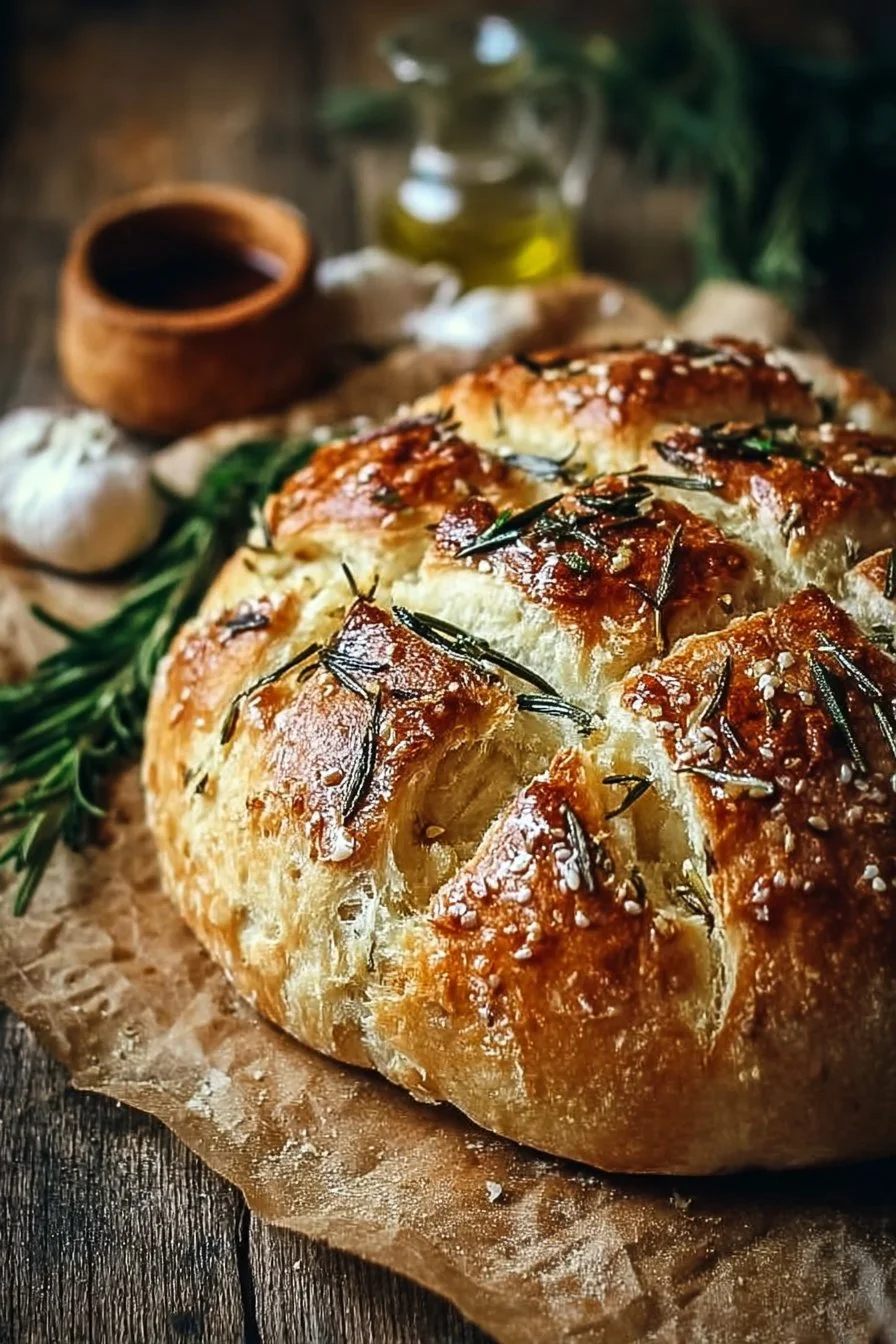
This rustic loaf smells like a woodsy bakery: sweet roasted garlic, piney rosemary, and a crackling, golden crust. It’s an easy artisan-style bread that uses a long room-temperature rise and a cold ferment to build flavor without fuss — perfect for weekend baking, dinner with soup, or slicing for sandwiches. For a similar method using a Dutch oven and extra-herby flavor, check this take on Dutch oven garlic rosemary bread to compare techniques and timing.
Why you’ll love this dish
This loaf turns simple pantry staples into something impressive. The roast garlic melts into the dough, adding sweetness and depth; fresh rosemary brightens the aroma; and the cold retarding step concentrates flavor without any complicated shaping. It’s a great beginner-friendly artisan loaf that still looks like you spent hours in the kitchen.
“A simple mix-and-wait technique that bakes into a sandwich-ready, tear-apart artisan loaf — the roasted garlic is the real showstopper.” — home baker review
Occasions:
- Family weekend brunch or casual dinner parties
- Homemade gifts (slice, wrap, and pair with flavored olive oil)
- Pairing with stews, salads, and antipasti
How this recipe comes together
This is a forgiving, mostly hands-off bread that follows three big phases:
- Roast garlic to mellow and sweeten the cloves.
- Mix into a sticky dough, proof at room temperature for 8–10 hours to develop structure.
- Shape briefly, cold ferment for depth, then bake in a preheated Dutch oven for a crackling crust.
The long first rise is the flavor engine — the cold fridge step lets the loaf develop a nuttier taste and chewier crumb. Baking in a covered Dutch oven traps steam for proper oven spring; removing the lid finishes the crust.
What you’ll need
- 1 whole head garlic, halved crosswise
- 1 tablespoon extra-virgin olive oil (divided)
- Coarse sea salt & freshly ground black pepper, to taste
- 1½ cups water, room temperature (~70°F / 21°C)
- 1 teaspoon active dry yeast
- 3 cups bread or all-purpose flour (about 360 g), plus more for dusting
- ½ teaspoon dried oregano
- 1 teaspoon kosher or fine sea salt
- 2 teaspoons finely chopped fresh rosemary, plus more for topping
Notes and substitutions:
- Bread flour gives a chewier crumb; all-purpose is fine for a softer loaf. If you want a simpler starting point, you can compare this to a 4-ingredient artisan bread for fewer flavor additions.
- If you only have garlic powder, reduce amount — fresh roasted garlic offers much better texture and flavor.
- Olive oil can be swapped for avocado or light vegetable oil if needed.
Step-by-step instructions
- Roast the garlic: Preheat oven to 400°F (204°C). Halve the garlic head across the cloves, drizzle 1/2 tablespoon olive oil over the cut sides, and season with salt and pepper. Wrap tightly in foil and roast about 40 minutes, until very soft and caramelized. Let cool, then squeeze the cloves from their skins into a small bowl — mash them lightly with a fork.
- Activate the yeast: In a small bowl, stir the yeast into the room-temperature water and let sit 10–15 minutes until foamy. If no foam forms, yeast may be inactive; start over with fresh yeast.
- Mix dough: In a large bowl, whisk together the flour, oregano, and salt. Add the activated yeast water, mashed roasted garlic, 1/2 tablespoon olive oil, and the finely chopped rosemary. Stir with a spatula until a shaggy, sticky dough forms. The dough will be tacky — that’s correct.
- First rise: Cover the bowl with a clean towel and leave at room temperature for 8–10 hours (longer in cooler kitchens) until doubled and airy.
- Shape and cold ferment: Lightly flour a work surface. Turn the dough out, fold it gently into a tight ball without knocking out all the air, and place seam-side up in a floured bowl or proofing basket. Cover and refrigerate 1–24 hours (up to 48 for more flavor).
- Preheat for baking: Place a Dutch oven (lidded) in your oven and preheat to 450°F (232°C) for at least 30 minutes.
- Score and bake: Remove the dough from the fridge, invert it onto parchment paper seam-side down. Dust top lightly with flour and score with a sharp blade. Using the parchment, lower the dough into the hot Dutch oven. Cover and bake 30 minutes. Uncover and bake another 15–20 minutes until deep golden and hollow-sounding when tapped.
- Cool: Transfer to a wire rack and let cool at least 1 hour before slicing to finish the crumb set.
Best ways to enjoy it
- Tear-and-dip: Serve warm with extra-virgin olive oil and flaky sea salt, or an herbed butter.
- Sandwiches: Thick-sliced with roasted vegetables, fresh mozzarella, or deli-style meats.
- As part of a meal: Pair with creamy soups (tomato basil, potato leek) or a sharp cheese board.
- Breakfast: Toast slices, rub with a cut clove of raw garlic for an instant garlic bread twist.
Storage and reheating tips
- Room temperature: Keep tightly wrapped in a linen bag or bread box for 2 days. Avoid plastic if you want to keep the crust crisp.
- Freezing: Slice, wrap in plastic, then foil, and freeze up to 3 months. Toast or reheat from frozen in a 350°F (177°C) oven until warmed through.
- Reheating: For a crisp crust, reheat whole or slices at 350°F (177°C) for 8–12 minutes. For quick slices, pop them in the toaster.
- Food safety: Because this is a low-moisture baked good, refrigeration is unnecessary and will stale the bread faster; freeze if you won’t eat it within 48 hours.
Helpful cooking tips
- Measure flour by weight when possible: 3 cups ≈ 360 g. Using a scale yields consistent dough.
- Don’t overwork: Handle the dough gently after the first rise to preserve air bubbles.
- Check yeast viability: Foamy yeast after 10–15 minutes means the yeast is active; no foam = discard and try fresh yeast.
- Scoring: A shallow, confident slash (about 1/4–1/2 inch deep) guides expansion and creates that classic look.
- Steam matters: The Dutch oven traps steam—don’t skip the covered bake, it gives better oven spring and a thin crackly crust.
- Cool fully before slicing: Cutting early leads to gummy crumb because moisture hasn’t redistributed.
Creative twists
- Cheese-stuffed: Add diced sharp cheddar or fontina in the center before shaping for a molten core.
- Herb swaps: Use thyme or sage instead of rosemary; or add 1 tablespoon chopped chives for a mild onion note.
- Whole-grain: Substitute up to 1 cup of whole wheat flour, but increase water by 1–2 tablespoons if dough feels too stiff.
- Olives & lemon: Fold in 1/2 cup chopped olives and a teaspoon of lemon zest for a Mediterranean spin.
- Dairy-free & vegan: This loaf is naturally dairy-free; use infused oils or flavored salts for extra richness.
Common questions
Q: Can I speed up the 8–10 hour rise?
A: Yes — place the dough in a warm (not hot) spot to shorten the first rise to 3–4 hours, but flavor will be less developed. Warmer proofing increases fermentation rate; watch the dough rather than the clock.
Q: My loaf is dense — what went wrong?
A: Common causes: inactive yeast, under-proofing, or degassing the dough too aggressively when shaping. Ensure yeast foams during activation, allow the dough to double, and handle gently.
Q: Do I have to use a Dutch oven?
A: A Dutch oven gives the best steam for oven spring and crust. If you don’t have one, bake on a preheated baking stone and place a pan of boiling water on the oven floor for steam during the first 10–15 minutes.
Q: Can I use instant yeast instead of active dry?
A: Yes. Use slightly less instant yeast (about 3/4 teaspoon) and you can mix it directly into the dry ingredients without pre-proofing, though proofing the yeast water still helps confirm activity.
Q: How ripe should the roasted garlic be?
A: You want soft, golden cloves that mash easily — not burnt. Roasting ~40 minutes at 400°F usually achieves a caramelized, mellowed garlic that blends into the dough.
If you’d like, I can convert the ingredient amounts to metric-only measurements or create a simplified timeline you can print for the kitchen.
Print
Rustic Garlic Rosemary Bread
- Total Time: 650 minutes
- Yield: 1 loaf
- Diet: Vegetarian
Description
An easy artisan-style loaf with sweet roasted garlic and fresh rosemary, perfect for weekend baking.
Ingredients
- 1 whole head garlic, halved crosswise
- 1 tablespoon extra-virgin olive oil (divided)
- Coarse sea salt & freshly ground black pepper, to taste
- 1½ cups water, room temperature (~70°F / 21°C)
- 1 teaspoon active dry yeast
- 3 cups bread or all-purpose flour (about 360 g), plus more for dusting
- ½ teaspoon dried oregano
- 1 teaspoon kosher or fine sea salt
- 2 teaspoons finely chopped fresh rosemary, plus more for topping
Instructions
- Roast the garlic: Preheat oven to 400°F (204°C), drizzle 1/2 tablespoon olive oil over halved garlic, season with salt and pepper, wrap in foil, and roast for about 40 minutes until soft. Let cool, then mash cloves.
- Activate the yeast: Stir the yeast into the room-temperature water and let sit for 10–15 minutes until foamy.
- Mix dough: In a large bowl, whisk together flour, oregano, and salt. Add activated yeast water, mashed roasted garlic, 1/2 tablespoon olive oil, and finely chopped rosemary. Stir until a sticky dough forms.
- First rise: Cover and leave dough at room temperature for 8–10 hours until doubled in size.
- Shape and cold ferment: Turn out dough onto floured surface, shape gently into a ball, and refrigerate for 1–24 hours.
- Preheat for baking: Place a lidded Dutch oven in the oven and preheat to 450°F (232°C) for at least 30 minutes.
- Score and bake: Remove dough from fridge, invert onto parchment paper, score with a blade, then lower into the hot Dutch oven. Cover and bake for 30 minutes, then uncover and bake for another 15–20 minutes until golden brown.
- Cool: Transfer to a wire rack and let cool for at least 1 hour before slicing.
Notes
Use bread flour for a chewier crumb; all-purpose flour is fine for a softer loaf. This bread is best enjoyed fresh but can be frozen for up to 3 months.
- Prep Time: 600 minutes
- Cook Time: 50 minutes
- Category: Bread
- Method: Baking
- Cuisine: Italian