
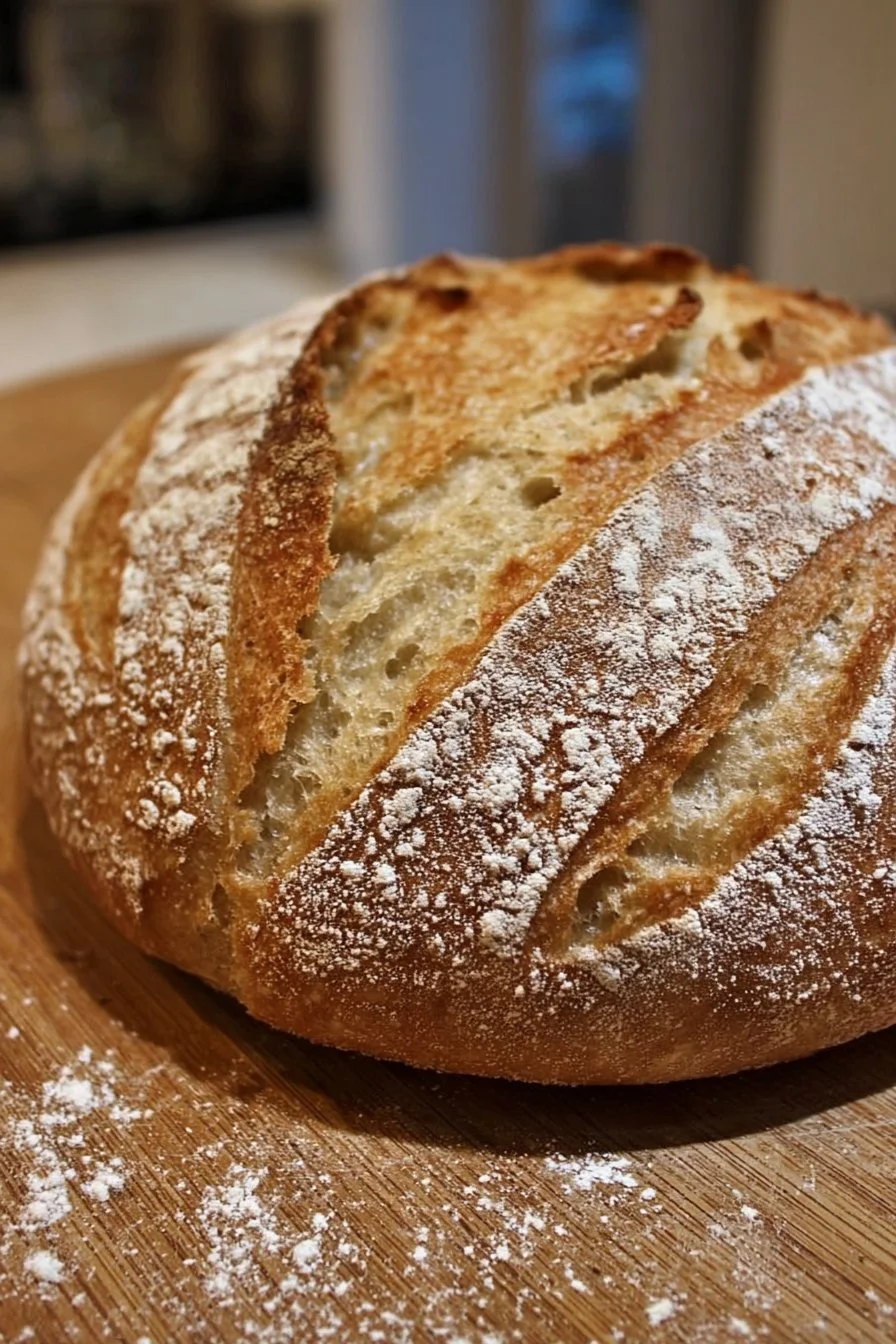
There’s something almost ritualistic about shaping a round sourdough boule, tucking it into a floured towel, and pulling a steaming, crackly loaf from a hot Dutch oven. This homemade sourdough loaf uses a big, active starter and minimal ingredients for a deeply flavored, tangy crumb that’s perfect for sandwiches, toast, or a weekend brunch centerpiece. If you need a faster loaf for busy nights, you might also like this 20-minute homemade bread recipe as a quick complement to your baking rotation.
What makes this recipe special
This loaf celebrates slow fermentation and a simple ingredient list: ripe starter, flour, water, and salt. Because it leans on a large amount of active starter (2 cups / 400 g), the dough ferments more quickly than low-starter formulas and develops a more pronounced sourdough tang and open crumb. It’s a great choice when you want reliable flavor without complicated additions.
“Rich, tangy flavor with a crisp, crackly crust — the kind of loaf that keeps your kitchen smelling like a bakery.” — home baker review
This recipe is ideal for:
- Weekend baking projects when you can plan a day for mixing, folding, chilling, and baking.
- Enjoying a naturally leavened loaf without complicated add-ins.
- Bakers who prefer a boule shape and the convenience of baking in a Dutch oven for consistent oven spring.
How this recipe comes together
This is a straightforward process broken into clear stages so you know what to expect:
- Mix starter and warm water to dissolve yeast activity.
- Add sifted flour and salt to form a wet, shaggy dough.
- Rest (bulk fermentation) with periodic stretch-and-folds to build gluten.
- Short bench rest and shape into a boule.
- Cold retard in the fridge for flavor development and easier scoring.
- Bake covered, then uncovered in a preheated Dutch oven for deep color and crisp crust.
The overall active hands-on time is modest; most of the clock time is passive resting, folding, and cold proofing.
What you’ll need
- 2 cups (400 g) active sourdough starter (ideally 100% hydration and bubbly). If your starter is denser/weird, you may need to adjust water slightly.
- 3 cups (360 g) sifted all-purpose flour. For more chew and flavor swap up to 25–30% bread flour or whole wheat.
- 1 cup (240 g) warm water, about 95–105°F (35–40°C). Warm, not hot—this wakes the starter.
- 1.5 teaspoons (9 g) salt.
Notes and substitutions:
- If using a less-active starter, feed it 4–8 hours before mixing so it peaks.
- For whole-grain variation, replace up to 30% of flour with whole wheat, rye, or spelt.
- If you don’t mind a slightly heavier loaf, use bread flour for more gluten strength.
How to prepare it
- In a large, non-metal mixing bowl, add 2 cups (400 g) active starter. Whisk in 1 cup (240 g) warm water until the starter is evenly dissolved and slightly frothy.
- Add the 3 cups (360 g) sifted all-purpose flour and 1.5 teaspoons (9 g) salt. Fold with a spatula until a wet, shaggy dough forms and no dry flour pockets remain.
- Cover the bowl and let the dough rest in a warm place (about 75–80°F / 24–27°C) for about 2 hours. This is the bulk rest; the dough should relax and begin to rise.
- Perform stretch-and-folds directly in the bowl: reach under one side, stretch the dough up and fold it over itself. Rotate the bowl and repeat for a total of 4–6 folds spaced over the first hour. These builds gluten without heavy kneading.
- After the final fold, let the dough rise until slightly puffed, about 45 minutes to 1 hour more. You want noticeable but not doubled volume.
- Lightly flour a work surface and turn the dough out. Gently pre-shape into a round, then let rest for 10–15 minutes.
- Shape into a tight boule by dragging and tightening the dough surface, creating surface tension. Place seam-side up in a bowl lined with a floured towel or into a floured proofing basket (banneton).
- Cover and refrigerate (cold retard) for 4 to 8 hours. Chilling firms the dough, deepens flavor, and makes scoring easier.
- Preheat your oven to 400°F (200°C) with a Dutch oven (lid on) inside for at least 30 minutes so the vessel is thoroughly hot.
- When ready, transfer the chilled dough (seam-side down now) onto a piece of parchment. Score the top with a sharp lame or razor (a single long slash or decorative pattern about 1/4–1/2 inch deep).
- Place the dough with parchment into the preheated Dutch oven. Cover and bake for 25 minutes to trap steam.
- Remove the lid and bake for another 25 minutes until the crust is deep golden brown and sounds hollow when tapped.
- Remove from the Dutch oven and cool completely on a rack for at least 1 hour before slicing. Cooling lets the crumb set and prevents a gummy interior.
Best ways to enjoy it
- Slice thick for avocado toast or thin for a toasted sandwich. The bold sour note pairs beautifully with sharp cheeses and cured meats.
- Serve warm with cultured butter and a sprinkle of flaky sea salt.
- Use stale slices for croutons, panzanella, or to make savory bread pudding.
For an even crunchier, more artisan-style crust, try combining these baking techniques with a method used in many successful recipes for crusty homemade artisan bread.
Storage and reheating tips
- Room temperature: Keep the cooled loaf in a paper bag or a loose bread bag for up to 2 days. Paper preserves crust better than plastic.
- Refrigeration: Not recommended for long-term storage—refrigeration dries bread faster. Use only if you live in a very humid climate; otherwise, freeze.
- Freezing: Slice the cooled loaf and freeze in an airtight bag for up to 3 months. Toast or thaw slices as needed.
- Reheating: For a revived crust and warm crumb, sprinkle the loaf with a little water, wrap in foil, and heat at 350°F (175°C) for 10–15 minutes, or place slices under a broiler for quick toasting.
- Food safety: If you see mold, discard the loaf. Sourdough is naturally acidic but that doesn’t prevent spoilage indefinitely.
Pro chef tips
- Starter activity: Use starter at peak activity (bubbly and doubling after feed). If unsure, feed it and wait until it peaks before mixing.
- Water temperature: Keep water warm but not hot. 95–105°F wakes your starter; hotter will kill yeast activity.
- Avoid metal bowls for fermentation—use glass, ceramic, or food-grade plastic. Metal can react slightly with acidic dough over long fermentations.
- Stretch-and-folds: These replace kneading. Four to six folds spaced over an hour should be enough to develop structure.
- Cold retard: Refrigeration tightens the dough and increases flavor depth; don’t skip it if you want a more complex taste.
- Scoring: Use a very sharp blade at a shallow angle for a nice ear. Practice on a scrap if you’re new.
- Don’t slice warm: Wait at least 1 hour after baking so the crumb finishes cooking and firms up.
Creative twists
- Seeded boule: Mix 2–3 tablespoons each of toasted sesame, sunflower, and flax seeds into the dough.
- Olive and herb: Fold in 1/2 cup chopped, pitted olives and 2 tablespoons chopped rosemary after the bulk rest.
- Whole-grain mix: Replace up to 30% of the all-purpose flour with whole wheat for nuttier flavor. Add 10–20 g extra water if the dough feels stiff.
- Garlic-parmesan: Brush the top with olive oil and sprinkle grated Parmesan just before the final bake for a savory crust.
- No Dutch oven? Bake on a preheated baking stone and create steam in the first 10 minutes by placing a pan of boiling water on the oven bottom or spraying the oven walls quickly with water.
Common questions
Q: How active does my starter need to be for this recipe to work?
A: It should be bubbly and at or near its peak after feeding. If it doesn’t float in a quick “float test,” give it more time to mature or feed it earlier so it’s active when you plan to mix.
Q: Can I shorten the chilling time or skip the fridge?
A: Yes—if you’re short on time you can do a room-temperature proof for a shorter period (1–3 hours) until slightly puffed, but flavor will be milder and shaping/scoring may be trickier.
Q: My loaf didn’t open much during baking. What went wrong?
A: Common causes are underproofing (dough too tight), dull scoring, or insufficient oven/ Dutch oven heat. Make sure the dough is cold when it hits the hot Dutch oven (for better oven spring), score enough depth, and fully preheat the pot.
Q: Can I use bread flour instead of all-purpose?
A: Yes. Bread flour increases gluten strength and chew. If you use bread flour only, you may get a slightly tighter crumb; mixing flours gives balance.
Q: How long will this loaf keep?
A: At room temperature in a paper bag, expect 1–2 days for optimal texture. Sliced and frozen, it will keep up to 3 months.
Enjoy the process—sourdough rewards patience and practice. Each bake teaches you a little more about your starter, your oven, and how you like your crust and crumb.
Print
Homemade Sourdough Boule
- Total Time: 65 minutes
- Yield: 1 loaf
- Diet: Vegetarian
Description
A delightful homemade sourdough loaf with a rich, tangy flavor and a crisp, crackly crust, perfect for sandwiches and toast.
Ingredients
- 2 cups (400 g) active sourdough starter
- 3 cups (360 g) sifted all-purpose flour
- 1 cup (240 g) warm water (95–105°F / 35–40°C)
- 1.5 teaspoons (9 g) salt
Instructions
- Add the active starter to a mixing bowl and whisk in warm water until dissolved.
- Blend in sifted all-purpose flour and salt to form a wet, shaggy dough.
- Cover and let the dough rest in a warm place for about 2 hours.
- Perform stretch-and-folds for about 4–6 folds spaced in the first hour.
- Transfer the dough to a floured surface and pre-shape into a round.
- Shape into a tight boule and place seam-side up in a floured bowl.
- Refrigerate for 4 to 8 hours for cold retard.
- Preheat your oven to 400°F (200°C) with a Dutch oven inside.
- Score the top of the dough and transfer it to the preheated Dutch oven.
- Bake covered for 25 minutes, then uncover and bake for another 25 minutes.
- Cool on a rack for at least 1 hour before slicing.
Notes
For best results, use an active starter. Adjust flour for whole-grain variations and ensure proper chilling for flavor development.
- Prep Time: 15 minutes
- Cook Time: 50 minutes
- Category: Bread
- Method: Baking
- Cuisine: French