
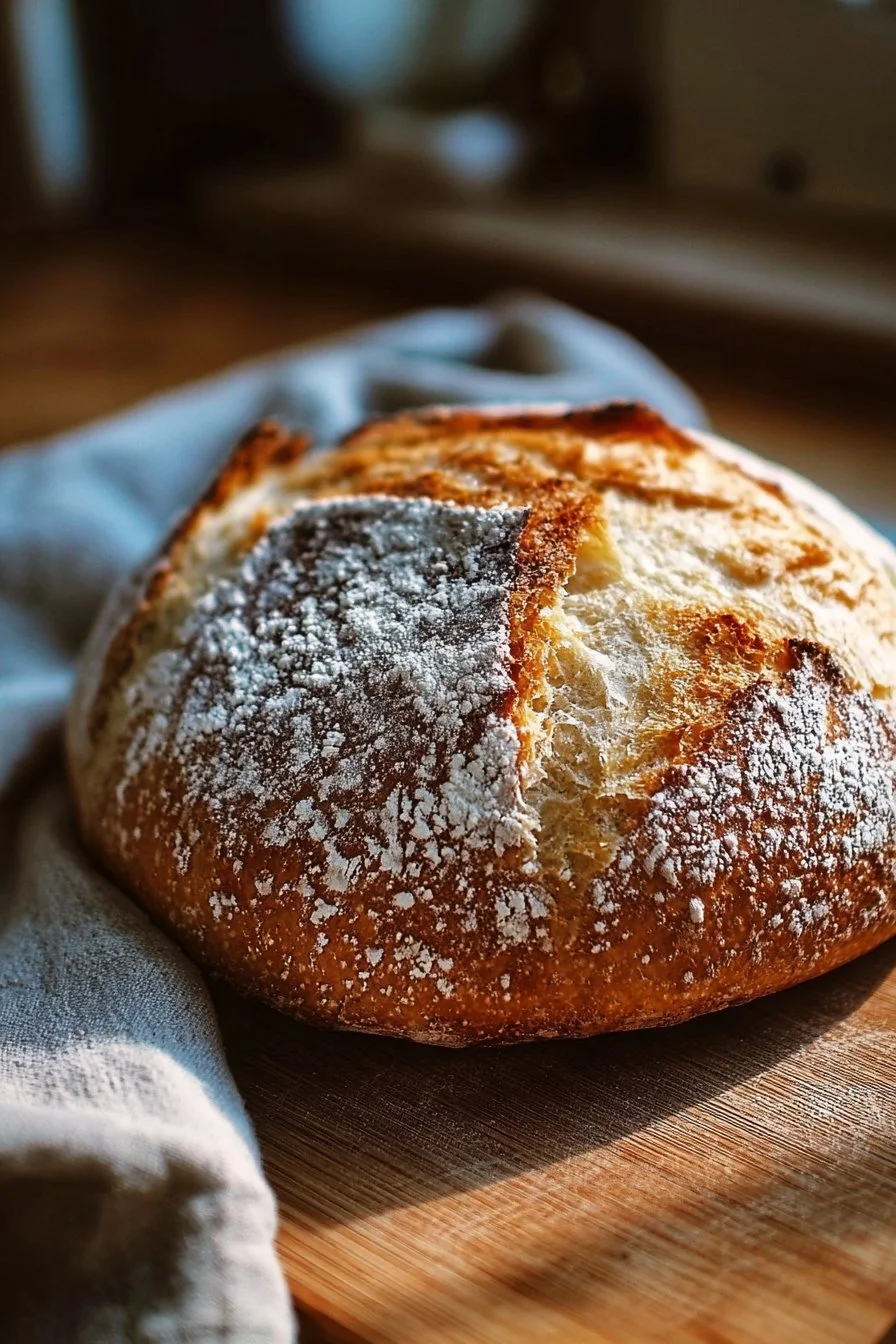
A good sourdough loaf is more than bread — it’s a morning ritual, a lunch companion and the kind of thing friends ask you to bring to dinner. This recipe yields a tangy, open-crusted boule with a chewy crumb and a crisp, golden crust. It’s approachable for home bakers who want genuine sourdough flavor without an intimidating, all-day schedule. If you want a faster loaf or a different technique to compare, see the helpful comparison with our 20-minute homemade bread guide.
Why you’ll love this dish
Sourdough is equal parts flavor, texture and satisfaction. You get a loaf with complex, slightly tangy taste from natural fermentation, an airy interior if properly handled, and a crust that snaps satisfyingly when you break it open. It’s also economical: flour, water, salt and starter — that’s it.
“This was my first sourdough that actually had an open crumb and real crust — the step-by-step stretch-and-folds made the difference.” — home baker review
Reasons to try it:
- Deep, layered flavor that improves with practice.
- Impressive results for guests — looks artisan but is doable at home.
- Flexible timing: daytime bulk ferment + overnight cold proof fits many schedules.
- Great for sandwiches, toast, soups and gifting.
How this recipe comes together
A quick roadmap so you know what to expect:
- Autolyse: flour + warm water rest to hydrate flour and kickstart gluten development (30 minutes).
- Mix: add active starter and salt; incorporate completely.
- Strength building: four sets of stretch-and-folds at 30-minute intervals over 2 hours.
- Bulk ferment: leave dough to mature 6–8 hours at room temperature until doubled and bubbly.
- Shape and chill: form a round/oval, place in a proofing basket and refrigerate 8–12 hours for flavor and easier scoring.
- Bake in a preheated Dutch oven at 450°F (232°C): covered 20 minutes, uncovered 25 minutes until deep golden.
This sequence balances hands-on time (short) with passive fermentation (long), which gives the sourdough its character.
What you’ll need
- 4 cups (500 g) bread flour or all-purpose flour — bread flour gives more structure; AP works fine.
- 1⅔ cups (375 g) warm water (about 75–85°F / 24–29°C) — measured by weight if possible.
- 1 cup (200 g) active sourdough starter, fed and bubbly — mature starter produces the best rise.
- 2 teaspoons (10 g) fine salt.
Quick ingredient notes and substitutions:
- Whole wheat: swap up to 20–30% flour with whole wheat for nuttiness (increase water slightly).
- Hydration: this is roughly 75% hydration (water weight ÷ flour weight). Reduce water by 10–20 g if your starter is wet or your dough feels too sloppy.
- Salt: don’t skip it — it controls fermentation and improves crust and crumb.
Step-by-step instructions
- Combine flour and warm water in a large bowl. Stir until a shaggy mass forms. Cover and rest 30 minutes (autolyse).
- Add the active, bubbly starter and the salt. Mix thoroughly until fully incorporated. The dough will be sticky but cohesive.
- Cover and leave at room temperature. Over the next 2 hours perform four sets of stretch-and-folds at 30-minute intervals: wet your hand, lift one side of the dough, stretch it up and fold over. Rotate the bowl and repeat 4–6 times per set.
- After the final fold, cover and bulk ferment for 6–8 hours at room temperature. The dough should roughly double and show bubbles on the surface and sides. Timing varies with temperature — warmer rooms shorten the time.
- Turn the dough gently onto a lightly floured surface. Shape into a round or oval by tucking the edges under to create surface tension. Be gentle to preserve gas.
- Place the shaped dough seam-side up in a floured proofing basket or a bowl lined with a floured towel. Cover and refrigerate 8–12 hours (cold retard enhances flavor and makes scoring easier).
- Preheat your oven to 450°F (232°C) with a Dutch oven (or cloche) inside for at least 30 minutes. This ensures a hot surface and instant steam.
- Remove the dough from the fridge, flip it onto parchment, and score the top with a sharp blade (a ¼–½ inch deep slash). Transfer the dough (on the parchment) into the hot Dutch oven.
- Cover and bake for 20 minutes. Remove the lid and bake for an additional 25 minutes, or until the crust is deep golden and sounds hollow when tapped.
- Transfer the loaf to a wire rack and cool completely before slicing — at least 1–2 hours. Cooling finishes the crumb structure; cutting too early yields a gummy interior.
How to serve Sourdough Bread
Best ways to enjoy it:
- Classic breakfast: thickly sliced, buttered and toasted. The tang cuts through rich butter beautifully.
- Sandwiches: sturdy enough for grilled cheese, Reuben or a substantial deli sandwich.
- With soups and stews: tearable crust and chewy crumb soak up broths and sauces.
- Cheese boards: pair with soft cheeses (brie, goat cheese), quince paste and honey.
For a simple presentation, slice on a diagonal, place on a wooden board with butter, olive oil and flaky salt.
Storage and reheating tips
Short-term storage:
- Keep at room temperature in a bread box or paper bag for 2–3 days. Avoid airtight plastic — it softens the crust.
Long-term storage: - Freeze whole or sliced: wrap tightly in plastic then foil or a freezer bag. Freeze up to 3 months. Thaw at room temperature.
Reheating: - To refresh crust, mist lightly with water and reheat in a 375°F (190°C) oven for 8–10 minutes. For slices, toast directly.
Safety note: refrigerating bread speeds staling; use refrigeration only if you plan to keep slices for more than 3 days or to slow mold growth in very humid climates.
Helpful cooking tips
- Starter strength matters: use a bubbly, recently fed starter for the most reliable rise. If it’s sluggish, give it a feed and wait until it doubles.
- Feel over time: oven spring and crumb improve when you watch dough activity, not the clock. Look for doubled volume and surface bubbles.
- Stretch-and-fold technique: you don’t need formal kneading. Four sets spaced 30 minutes apart develop strength without heavy work.
- Scoring: use a sharp razor or lame; shallow, confident cuts direct the oven spring. Don’t press too hard.
- Steam is essential: the Dutch oven provides steam to let the loaf expand before the crust sets. If you don’t have one, put a tray of hot water in the oven and spray the oven walls with water a couple of times during the first 10 minutes.
- For visual guidance and variations on technique, check a detailed method at this sourdough basics and technique resource.
Creative twists
- Seeded miche: fold in 3–4 tbsp mixed seeds (sunflower, flax, sesame) during the final fold.
- Olive & herb loaf: press chopped, oil-cured olives and fresh rosemary into the dough before the final shape.
- Whole grain: replace 100 g of the white flour with freshly milled whole wheat — hydrate more if needed.
- Rye sourdough: swap 100–150 g for rye flour and reduce hydration slightly; expect a denser crumb and deeper flavor.
- Cinnamon-sugar swirl: roll the dough flat, sprinkle cinnamon-sugar, roll, and proof for a sweet loaf variation.
FAQ
Q: How do I know my starter is “active” and ready?
A: An active starter will double (or near-double) within 4–8 hours after feeding at room temperature, be bubbly and have a pleasant tangy smell. A simple float test (a spoonful floats in water) can indicate readiness, but visual activity is more reliable.
Q: Can I speed up the bulk fermentation?
A: Warmer temperatures accelerate fermentation. If your kitchen is cool, place the dough in a slightly warmer spot (on top of a warm oven or in an oven with the light on). Be careful — too warm (>85°F / 29°C) risks over-fermentation and a weak structure.
Q: Do I have to use a Dutch oven?
A: No, but it helps create steam and a better crust. If you don’t have one, bake on a preheated baking stone or baking sheet, add a tray of boiling water to the oven for steam, and spritz the oven walls with water during the first 5–10 minutes.
Q: How long should I wait before slicing?
A: Cooling for at least 1–2 hours is important. The crumb continues to set as it cools; cutting too early often results in a gummy interior.
Q: Can I add commercial yeast for a faster rise?
A: Yes — a pinch (¼ tsp) of instant yeast can speed fermentation and make results more consistent for beginners, but it changes the character away from purely wild-fermented sourdough.
Q: Why is my crumb dense?
A: Common reasons: underproofing (need more bulk or final proof), not enough strength development (do more stretch-and-folds), or degassing the dough too aggressively while shaping. Also check starter vitality.
Classic Sourdough Bread
- Total Time: 8 hours 45 minutes
- Yield: 1 loaf
- Diet: Vegetarian
Description
A tangy, open-crusted sourdough loaf with a chewy crumb and a crisp, golden crust, perfect for any occasion.
Ingredients
- 4 cups (500 g) bread flour or all-purpose flour
- 1⅔ cups (375 g) warm water (75–85°F / 24–29°C)
- 1 cup (200 g) active sourdough starter, fed and bubbly
- 2 teaspoons (10 g) fine salt
Instructions
- Combine flour and warm water in a large bowl. Stir until a shaggy mass forms. Cover and rest 30 minutes (autolyse).
- Add the active, bubbly starter and the salt. Mix thoroughly until fully incorporated.
- Cover and leave at room temperature. Over 2 hours perform four sets of stretch-and-folds at 30-minute intervals.
- After the final fold, cover and bulk ferment for 6–8 hours at room temperature until the dough has doubled and shows bubbles.
- Turn the dough gently onto a lightly floured surface. Shape into a round or oval.
- Place the shaped dough seam-side up in a floured proofing basket. Cover and refrigerate 8–12 hours.
- Preheat your oven to 450°F (232°C) with a Dutch oven inside for at least 30 minutes.
- Remove the dough from the fridge, flip onto parchment, and score the top.
- Cover and bake for 20 minutes. Remove the lid and bake for an additional 25 minutes until the crust is deep golden.
- Transfer the loaf to a wire rack and cool completely before slicing — at least 1–2 hours.
Notes
Use a bubbly, recently fed starter for the best rise. Be gentle when shaping to preserve gas in the dough.
- Prep Time: 60 minutes
- Cook Time: 45 minutes
- Category: Bread
- Method: Baking
- Cuisine: American