
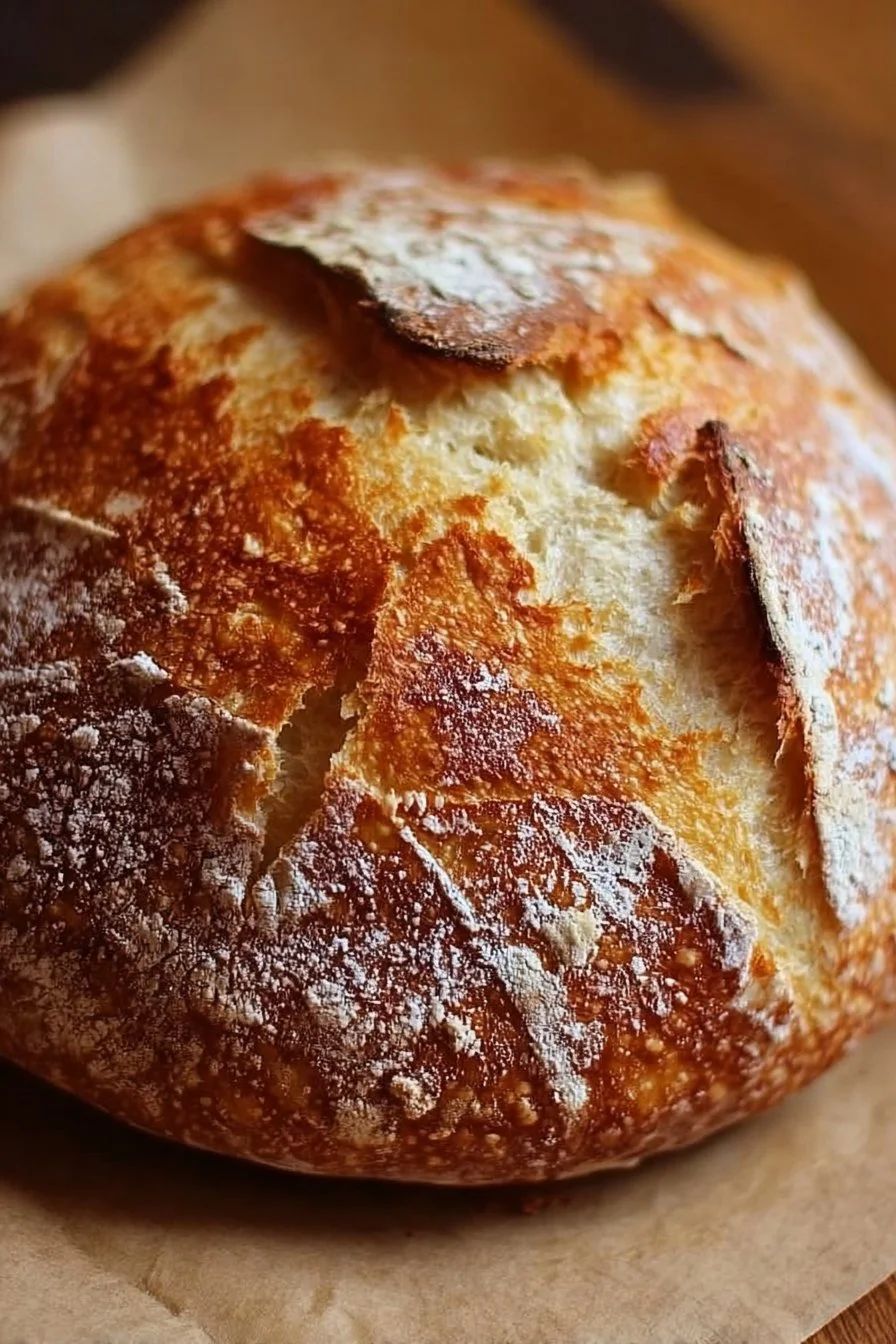
This 4-ingredient artisan loaf gives you crisp, crackly crust and an open, chewy crumb with almost no effort. It’s the classic no-knead, long-fermentation bread that feels artisanal but requires only flour, yeast, salt, and warm water. Make it for a weekend brunch, an easy dinner side, or whenever you want fresh-baked bread without an afternoon of work. If you enjoy fuss-free bread projects, you might also like this take on a savory pull-apart: chicken alfredo monkey bread.
Why you’ll love this bread
This loaf hits a sweet spot between simplicity and bakery-quality results. There’s no kneading, no fancy equipment, and the long, slow room-temperature fermentation does the heavy lifting, developing flavor and texture like a pro would.
"Baked once a week now—crispy outside, soft inside, and impossible to mess up." — A reader’s quick take after trying the recipe
Reasons to try it:
- Minimal ingredients and hands-on time.
- Big flavor from gentle fermentation.
- Perfect for beginners who want a bakery-style loaf without daily maintenance.
The cooking process explained
You’ll mix, wait, shape, proof, and bake. First you whisk dry ingredients, add warm water, and stir to a shaggy dough. Let it sit 12–18 hours to ferment and develop flavor. Then you gently form a rough ball, proof on parchment for an hour or two, and bake it in a preheated Dutch oven so steam creates a blistered crust. Thirty minutes covered, then 15–25 uncovered gives deep color and crunch.
What you’ll need
- 3 cups all-purpose flour (around 400 g)
- 1/4 teaspoon instant yeast
- 1 1/2 teaspoons fine sea salt or kosher salt
- 1 1/2 cups warm water (about 355–360 ml) at 105–115°F / 40–46°C
Notes and substitutions:
- Instant yeast: can use active dry yeast (increase to 1/2 tsp and proof in the water for 5–10 minutes until bubbly).
- Flour: all-purpose works well; for a slightly denser crumb, substitute up to 1 cup whole wheat (expect to add 10–20 ml more water).
- Salt: fine sea salt or kosher are preferred for even distribution.
Step-by-step instructions
- In a large bowl whisk the flour, salt, and instant yeast until combined.
- Pour the warm water into the bowl and mix with a sturdy spoon until a shaggy, sticky dough forms. It will be loose and wet—this is normal.
- Cover the bowl tightly with plastic wrap or a lid. Let it ferment at room temperature (about 68–75°F / 20–24°C) for 12–18 hours. Look for bubbles and a dome-like rise.
- Lightly flour your work surface and gently scrape the dough out. Fold the edges toward the center a few times to form a loose ball—don’t degas it completely.
- Place the dough seam-side down on a sheet of parchment. Dust the top with flour and let it rise uncovered for 1–2 hours until puffy.
- Preheat your oven to 450°F (232°C) with a Dutch oven inside for at least 30 minutes so the pot is blazing hot.
- Score the dough with a sharp blade or lame to control expansion. Using the parchment, lift and transfer the dough into the hot Dutch oven. Cover and bake for 30 minutes.
- Remove the lid and bake another 15–25 minutes until the crust turns deep golden brown. If desired, rotate the pot once for even coloring.
- Carefully remove the loaf and cool on a rack for at least 1–2 hours before slicing to set the crumb.
Best ways to enjoy it
Serve this bread warm with salted butter, olive oil and balsamic, or alongside soups and stews. It’s also excellent for sandwiches—the open crumb soaks up dressings and sauces without getting soggy. For a simple show-stopper: slice, rub with a cut clove of garlic, drizzle with olive oil, and sprinkle flaky salt.
Storage and reheating tips
- Room temperature: keep the loaf in a paper bag or lightly wrapped in a clean kitchen towel for 1–2 days. Avoid tight plastic at room temp—it softens the crust.
- Refrigerator: not recommended for fresh bread; refrigeration accelerates staling.
- Freezing: slice the cooled loaf, wrap well in plastic, then foil, and freeze up to 3 months. Toast or reheat directly from frozen.
- Reheating: warm slices in a 350°F (175°C) oven for 8–10 minutes to refresh the crust, or toast individual slices.
Helpful cooking tips
- Water temperature: 105–115°F (40–46°C) is ideal for controlled fermentation with instant yeast. Too hot kills yeast; too cool slows the rise.
- Dough feel: the dough should be tacky and loose, not dry. Resist adding flour while mixing—wet dough equals an open crumb.
- Folding technique: use wet hands or a bench scraper to handle the sticky dough; do gentle folds to build surface tension.
- Preheat the pot: a thoroughly heated Dutch oven gives rapid steam and oven spring—don’t skip this step. Use oven mitts and be careful when placing the dough in the hot pot.
- Scoring: a shallow, decisive slash helps the loaf open where you intend. Practice on a piece of parchment if you’re new to it.
Creative twists
Change the loaf by folding inclusions into the dough after the first fermentation: olives, roasted garlic, chopped rosemary, or shredded parmesan. For more herb-forward inspiration baked in a pot, try this Dutch oven garlic rosemary bread. Other ideas:
- Sesame or everything bagel topping: brush with water and press seeds on before baking uncovered.
- Cheesy version: fold 3/4–1 cup grated sharp cheddar into the dough during shaping.
- Whole-grain: replace up to 1 cup of flour with whole wheat and add 10–20 ml more water.
FAQ
Q: How long does this take start-to-finish?
A: Active hands-on time is under 30 minutes. Total time including the long fermentation and final bake is about 14–20 hours, mostly hands-off.
Q: Can I speed up the fermentation?
A: Yes—raise the water temperature slightly (not above 115°F / 46°C) and ferment in a warmer spot to shorten the bulk rise to 8–10 hours, but flavor will be less developed.
Q: Do I have to use a Dutch oven?
A: No, but it helps create steam for a great crust. Alternatively, bake on a preheated baking stone and add a tray of boiling water to the oven for steam during the first 10 minutes.
Q: Why did my loaf collapse or have a gummy center?
A: Likely underbaked or the dough was too wet and not given enough time to set in the oven. Ensure proper preheat, bake long enough after removing the lid, and cool at least an hour before slicing.
Q: Can I use instant yeast from a new packet or does it expire?
A: Yeast loses power over time. If your packet is older than its best-by date, proof 1/4 tsp in the warm water with a pinch of sugar to check for activity before relying on it.
Enjoy the process—this recipe rewards patience, not elbow grease. Try it once and you’ll likely keep this simple loaf in your rotation.
Print
No-Knead Artisan Loaf
- Total Time: 720 minutes
- Yield: 1 loaf
- Diet: Vegetarian
Description
A simple artisan loaf that achieves a crispy crust and chewy crumb without kneading, made from just four ingredients.
Ingredients
- 3 cups all-purpose flour (around 400 g)
- 1/4 teaspoon instant yeast
- 1 1/2 teaspoons fine sea salt or kosher salt
- 1 1/2 cups warm water (about 355–360 ml) at 105–115°F / 40–46°C
Instructions
- In a large bowl whisk the flour, salt, and instant yeast until combined.
- Pour the warm water into the bowl and mix with a sturdy spoon until a shaggy, sticky dough forms.
- Cover the bowl tightly with plastic wrap or a lid and let it ferment at room temperature for 12–18 hours.
- Lightly flour your work surface and gently scrape the dough out, folding the edges toward the center to form a loose ball.
- Place the dough seam-side down on a sheet of parchment, dust the top with flour, and let it rise uncovered for 1–2 hours until puffy.
- Preheat your oven to 450°F (232°C) with a Dutch oven inside for at least 30 minutes.
- Score the dough with a sharp blade and transfer it into the hot Dutch oven using the parchment.
- Cover and bake for 30 minutes, then remove the lid and bake for another 15–25 minutes until deep golden brown.
- Carefully remove the loaf and cool on a rack for at least 1–2 hours before slicing.
Notes
For variations, try adding olives, roasted garlic, or cheese. Store in a paper bag or towel at room temperature.
- Prep Time: 15 minutes
- Cook Time: 45 minutes
- Category: Bread
- Method: Baking
- Cuisine: Artisan